From Passive Learners to Historians: How Digital Portfolios Help Students Take Ownership of Learning
Chalice McKnight
Lamar University
EDLD 5317: Resources Digital Environments
Target Publications: TechTrends, Middle School Journal, Edutopia


This moment may seem small, but it represented a meaningful shift in learning. The student was no longer waiting for the teacher to identify what she needed to improve. She was evaluating her own progress, identifying areas for growth, and creating a plan for improvement mid-class, without being prompted. That shift did not happen by accident. It was the result of a structured learning environment in which digital portfolios, consistent reflection, and intentional goal setting worked together to give students a genuine stake in their own progress.
As educators, we often talk about student ownership, but ownership cannot be assigned. It must be developed through experiences that encourage students to reflect, make decisions, and take responsibility for their progress. Hughes and Roblyer (2023) remind us that technology is most effective when it becomes invisible in the learning environment, serving as a vehicle for deeper engagement rather than an end in itself. The digital portfolio model described in this article embodies that principle.
The Problem: Learning as Compliance
Many middle school students approach learning as a series of assignments completed for points rather than as opportunities for growth. In traditional classrooms, students often depend on teachers to identify strengths, weaknesses, and next steps. This dependence can limit engagement and reduce opportunities for self-directed learning.
At the same time, teachers face increasing demands. Differentiation, engagement, data analysis, test preparation, and diverse learning needs compete for limited instructional time. New technology initiatives are often introduced as solutions, but many end up as additional tasks rather than valuable improvements.
The challenge is not finding more technology. The challenge is to create learning environments where students are active participants in their own education. As Dewey argued, authentic learning requires students to do, reflect, and connect new experiences to prior knowledge, rather than simply receiving information (as cited in Hughes & Roblyer, 2023). Station rotation and digital portfolios create structural conditions for exactly that kind of learning.
The Innovation: Blended Learning Joins Digital Portfolios
Station Rotation Model
The instructional framework at the core of this innovation constitutes the station-rotation model of blended learning. Students rotate through three stations each class period: a teacher-led small group, a collaborative peer station, and an independent digital learning station. This structure, supported by research from Fulbeck (2020) and Xiangze and Abdullah (2023), provides students with varied pathways into the content and creates natural opportunities for both teacher-directed feedback and student-initiated inquiry. Each station is designed to target a different dimension of engagement. The teacher-led station addresses behavioral engagement using structured participation; the collaborative station fosters emotional engagement through peer connection; and the digital station cultivates reflective engagement through self-paced, reflective tasks that feed directly into every student's portfolio.
Figure 1. The Station Rotation Model: Students rotate through three stations each class period.

The Digital Portfolio as a Learning Engine
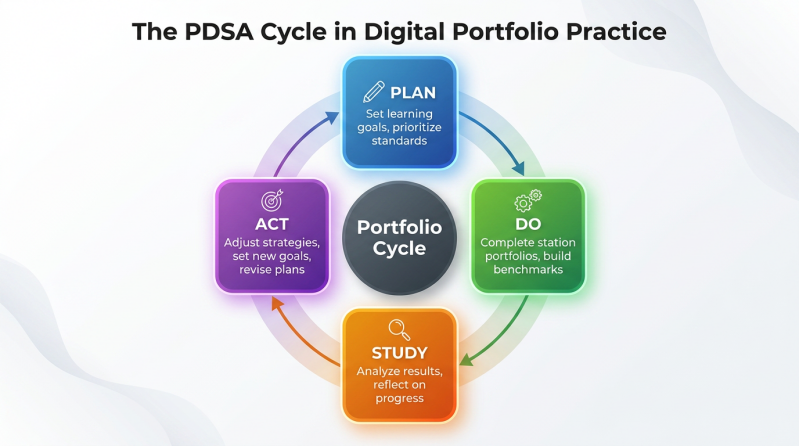
Rather than functioning as a digital folder of completed work, the portfolio in this model acts as a tool for reflection, planning, and self-evaluation. Students collect artifacts, analyze their own assessment data, set learning goals, and complete structured reflections using the Plan-Do-Study-Act (PDSA) cycle, a framework Mertler (2020) identifies as highly well-suited to action research and continuous improvement in classroom settings. This process shifts the focus from grades to growth. Students who previously asked "What did I get?" begin asking "What do I still need to learn?" That cognitive shift from product orientation to process orientation is one of the clearest indicators of developing self-regulation (Zimmerman, 2002, as cited in Lam, 2022).
Figure 2. The PDSA Cycle has a portfolio reflection structure. Students plan goals, complete work, study their results, and act on what they learn.
Theoretical Grounding: Why This Works
This approach is based on constructivist learning theory. Vygotsky's social development theory supports the collaborative station structure, while Bruner's concept of scaffolded discovery learning explains why students need guided reflection prompts before they can reflect independently. Piaget's emphasis on active construction of knowledge underpins the portfolio process itself: students are not consuming content but building a personal record of how their understanding evolves.
Hughes and Roblyer (2023) describe this kind of learning environment as one in which technology functions as a "mind tool,” an instrument that extends students' cognitive capacity rather than replacing thinking. The digital portfolio functions precisely this way. It does not do the learning for students; it makes their learning visible to them in ways that paper-and-pencil tasks cannot.
Roger Schank's cognitive science framework adds another dimension: learning sticks when it is connected to meaningful doing and reflection. Schank argues that humans learn mainly through experience and relating rather than through passive reception (as cited in Education Futures, 2011). When students construct portfolio narratives about their own progress, explaining what they tried, what worked, and what they will do differently, they are engaging in exactly the kind of story-centered learning Schank identifies as most durable.

Student Engagement: Three Dimensions That Matter
Fredricks, Blumenfeld, and Paris (2004) identify three interconnected dimensions of engagement that, in combination, predict academic success: behavioral, emotional, and cognitive. Effective instructional design must address all three, not just one. The blended learning and portfolio model tackles all three dimensions simultaneously. Station rotation structures create consistent behavioral engagement through movement, task variety, and engagement expectations. The collaborative and teacher-led stations foster emotional participation through a sense of inclusion and feedback. And the portfolio's reflective demand goal setting, self-assessment, and PDSA cycles, and develop the cognitive engagement that research most strongly links to achievement outcomes (Lei et al., 2018). A meta-analysis of 69 independent studies involving nearly 200,000 participants found a moderately strong and positive correlation between overall learner involvement and academic achievement. Of the three domains, cognitive engagement, specifically the use of deep learning strategies and self-monitoring, had the strongest relationship with academic achievement across grade levels and subject areas (Lei et al., 2018).
Figure 3. Three dimensions of student engagement (Fredricks et al., 2004).

Learning Through Reflection: What the Classroom Showed
One of the most valuable aspects of digital portfolios is the opportunity for structured reflection. Initially, many students found it difficult to evaluate their own learning. Responses were often brief and focused on grades rather than understanding.
Through modeling, guided prompts, and persistent practice, students began to develop a deeper reflective capacity. Instead of writing "I got a 70," students began explaining why they struggled, which study strategies they used, and how they planned to approach the next unit differently. Reflection became a learning activity rather than a checkbox on an assignment. The shift from "What did I get?" to "What do I still need to learn?" happened gradually, over weeks of regular practice.
Garcia (2025) found that students who maintained their own electronic portfolios demonstrated higher levels of motivation and reflection over time, with the most significant gains appearing after the first four to six weeks of implementation, consistent with what was observed in this classroom. Lam (2022) similarly found that e-portfolio use supports self-regulated and co-regulated learning, with students developing stronger metacognitive skills the longer they engage with the portfolio process.

Lessons Learned
Ownership Develops Gradually
The most important lesson from this work is that student ownership is not a switch that can be flipped on or off. It develops through steady, structured experiences over time. Students needed scaffolding before they could be independent. A Webador portfolio template and guided PDSA prompts reduced anxiety and gave students a clear starting point. As students became increasingly comfortable with the process, support was gradually removed.
Teacher Modeling Is Essential
Students needed to see what good reflection looked like before they could produce it themselves. Think-aloud, exemplars, and teacher-completed PDSA cycles modeled the cognitive process of self-assessment. Over time, students internalized the structure and began applying it independently, which is precisely the goal of any instructional scaffold.

Technology Must Serve Learning
Technology itself does not create engagement. Students were most engaged when technology supported meaningful learning experiences rather than serving as the focus of instruction. The digital portfolio succeeded because it helped students think about their learning, not because it was digital. Hughes and Roblyer (2023) make this point explicitly: the value of educational technology is found in its ability to enhance and extend learning, not in novelty or access alone.
Effects for Educators
If you teach middle school students, you understand the reality of managing multiple class periods, multiple learning needs, and limited instructional time. This approach is not about adding another responsibility to an already full plate. It is about creating structures that progressively transfer responsibility for learning from teacher to student.
Teachers do not need elaborate technology systems to begin. A simple digital portfolio platform, consistent opportunities for reflection, and a commitment to student voice can begin shifting the locus of control in the classroom. Several starting points are low-barrier and immediately actionable: beginning with one reflection prompt per week tied to a completed assessment; introducing a two-station rotation before expanding to three; using free portfolio platforms such as Google Sites, Seesaw, or Webador before investing in paid tools; modeling the PDSA cycle using one's own professional learning goals; and celebrating growth over grades within class discussions and student conferences.
For instructional coaches and campus administrators, this model also delivers a replicable framework for professional learning communities. The same PDSA structure students use to reflect on their learning can be used by teacher teams to reflect on instructional data, creating alignment between how we want students to learn and how we learn as professionals.
Conclusion
Technology ought to support learning, not dominate it. When deliberately implemented within a blended learning structure, digital portfolios can move students beyond compliance and toward genuine ownership of their educational journey. The goal is not a more polished portfolio website or higher test scores in isolation. The goal is to help students develop the capacity to reflect, plan, evaluate, and act on what they know, skills that reach far beyond any single content area or grade level. When students begin asking themselves what they need to learn next, rather than waiting for someone else to tell them, meaningful learning has begun.
References
Education Futures. (2011). Roger Schank on invisible learning: Real learning, real memory. https://educationfutures.com/blog/post/roger-schank-invisible-learning
Fredricks, J. A., Blumenfeld, P. C., & Paris, A. H. (2004). School engagement: Potential of the concept, state of the evidence. Review of Educational Research, 74(1), 59–109. https://doi.org/10.3102/00346543074001059
Fulbeck, E. S. (2020). Personalizing student learning with station rotation. American Institutes for Research. https://www.air.org/sites/default/files/Station-Rotation-Research-Brief-Final-July-2020.pdf
Garcia, M. B. (2025). Self-coded digital portfolios as an authentic project-based assessment tool. Education Sciences, 15(9), 1150. https://doi.org/10.3390/educsci15091150
Hughes, J. E., & Roblyer, M. D. (2023). Integrating educational technology into teaching: Transforming learning across disciplines (9th ed.). Pearson.
Lam, R. (2022). E-portfolios for self-regulated and co-regulated learning. Frontiers in Psychology, 13, 1079385. https://doi.org/10.3389/fpsyg.2022.1079385
Lei, H., Cui, Y., & Zhou, W. (2018). Relationships between student engagement and academic achievement: A meta-analysis. Social Behavior and Personality: An International Journal, 46(3), 517–528. https://doi.org/10.2224/sbp.7054